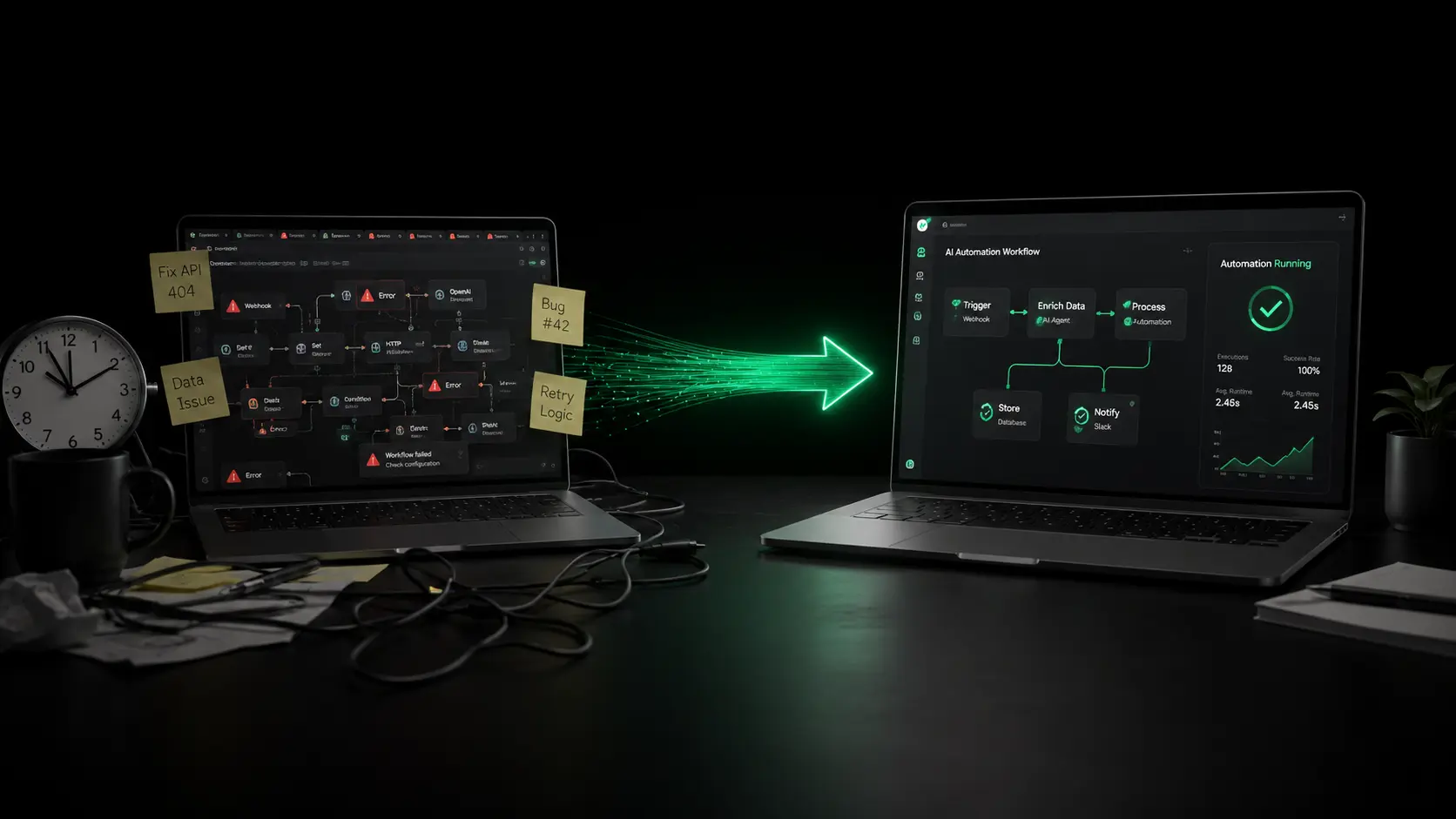
"Can't we just build this ourselves?" comes up on nearly every strategy call. It's a fair question — most businesses have someone technical on staff, or know someone who could probably figure it out. Here's the honest breakdown of when that instinct is right, and where it usually goes wrong.
Reason #1: Speed to a working system
An in-house build usually means someone learns the tools while building the workflow — evaluating platforms, figuring out API quirks, hitting the same beginner mistakes an experienced team already worked through years ago. That learning curve isn't wasted time exactly, but it is time your business doesn't get the workflow's benefit.
An automation company has already made those mistakes on someone else's project. The first version they hand you skips the trial-and-error phase entirely.
Reason #2: It's not your team's core job
The person who ends up owning an in-house automation project is usually someone whose actual role is something else — ops manager, marketing lead, a developer pulled off product work. The automation becomes a side project competing with their real responsibilities, which means it either takes far longer than planned or gets a fraction of the attention it needs to actually work well.
An automation company's only job on your account is the automation. Nothing competes for that attention.
Reason #3: Maintenance doesn't stop at launch
This is the piece that in-house estimates usually miss. A workflow that works perfectly at launch will eventually break — a connected tool changes its API, a field gets renamed, an edge case nobody tested shows up in month three. Someone needs to notice, diagnose, and fix it.
In-house, that responsibility usually falls back on whoever built it, on top of their regular job. With an agency, ongoing monitoring and fixes are typically part of the relationship, not an emergency interruption to someone's week.
Reason #4: Broader pattern recognition
An in-house builder has seen exactly one business's data and workflows: yours. An automation company that works across multiple clients has seen dozens of variations of the same underlying problem — different CRMs, different team sizes, different failure modes. That cross-client pattern recognition is hard to replicate with a single internal hire, no matter how skilled they are.
This shows up in small but important ways: knowing which integration is reliable versus which one silently drops data under load, or which approach to a workflow tends to get adopted by a team versus quietly ignored.
Reason #5: You get a system, not a person-dependent process
When one person builds and owns your automation in-house, that person becomes a single point of failure. If they leave, get pulled onto another project, or are simply out sick during a critical week, the system's reliability goes with them.
A properly built external engagement documents the system, not just the code — so the workflow doesn't live only in one person's head.
When in-house is actually the better call
To be fair to the other side: if you have a technical team with bandwidth to spare, a genuinely simple integration need, and no urgency, building in-house can work fine. The math changes when the workflow is complex, time-sensitive, or sits close to revenue — that's where the cost of getting it wrong outweighs the cost of getting outside help.
The real question isn't "can we build this ourselves" — most technical teams probably can, eventually. It's "is this the best use of that team's time compared to what an outside team could deliver faster, with less risk."
If you're weighing that trade-off for a specific workflow, that's exactly what we help sort out on a free strategy call — including an honest answer if in-house is genuinely the better path for your situation.
A2B AI Technologies builds custom AI automation, AI agents, and RAG-based systems for businesses that want results without the learning curve. Explore our services →
Follow along: Instagram @a2bai.tech · a2b.services · info@a2b.services