Most business owners comparing an agency against a freelancer default to comparing price. That's the wrong starting point. The real differences show up after the workflow goes live — in what happens when it breaks, when your business changes, or when you want to build on top of what you already have.
Here's what actually changes, not what sounds good on a sales page.
What stays the same
Both a good freelancer and a good agency can build a working automation. Neither one is inherently more "technical" or more capable of connecting your tools. A skilled freelancer can absolutely ship something that works on day one — sometimes faster and cheaper than an agency would.
If your need is narrow, one-off, and unlikely to need ongoing support — a single Zapier-style connection, a one-time data migration — a freelancer is often the right call, and we'd tell you that on a strategy call rather than pretend otherwise.
What changes: continuity
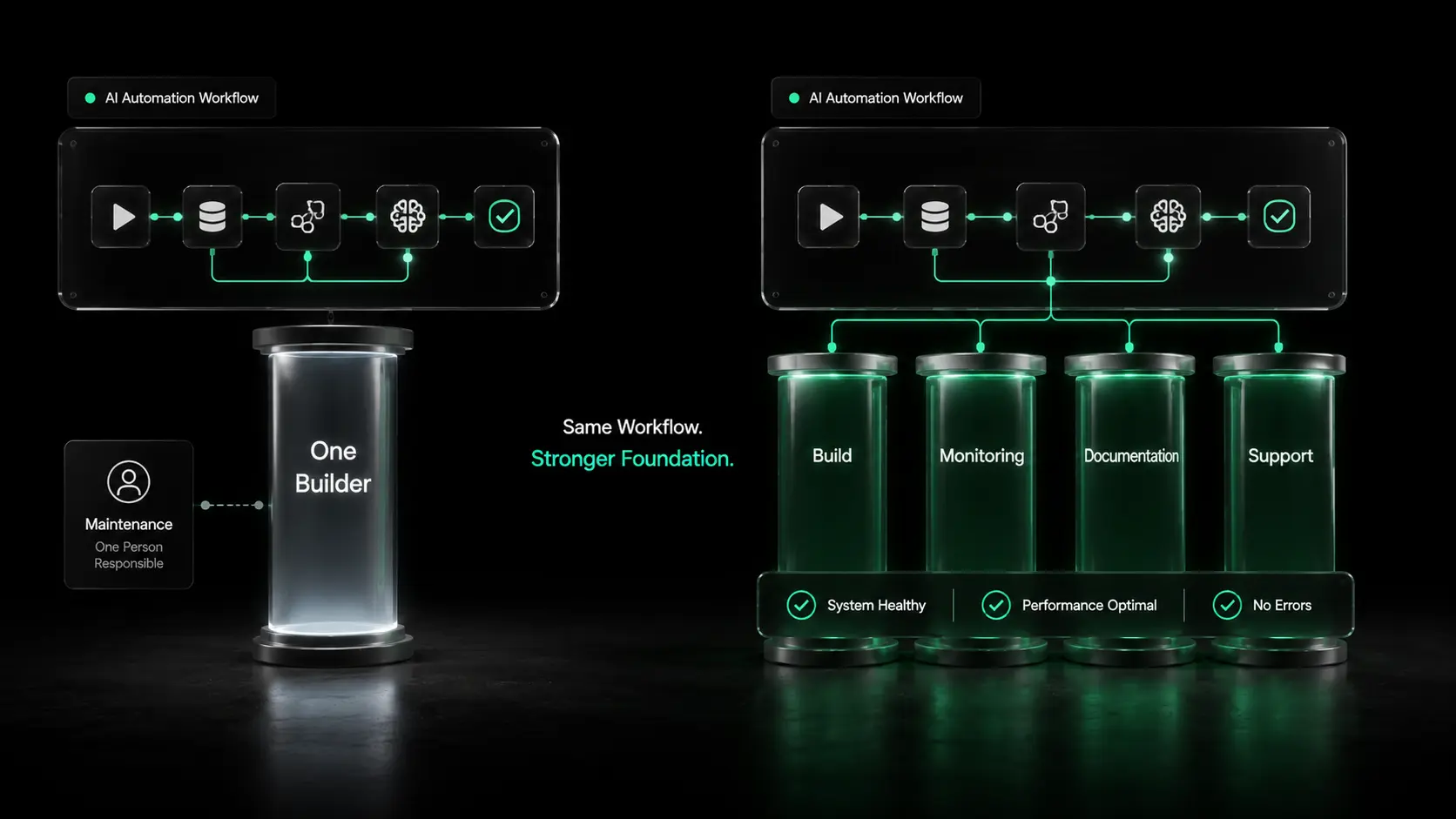
A freelancer is one person. When they take on their next project, get busy, or move on entirely, your automation is running on knowledge that lives in one person's head — not documented, not backed up by anyone else who understands the build.
An agency spreads that knowledge across a team. If the person who originally built your workflow isn't available, someone else can pick up the documentation and keep it running. This matters most six months after launch, when the workflow has been running quietly and something changes upstream — an API updates, a tool you rely on shifts its pricing tier, a field gets renamed in your CRM.
What changes: scope of responsibility
A freelancer typically owns the build. An agency typically owns the outcome.
That's a real distinction. When something breaks at 11pm before a client deadline, "who do I call" is a very different question depending on which one you hired. A freelancer's contract usually ends at delivery. An agency's relationship usually includes what happens after — monitoring, fixes, and adjustments as your workflow runs into edge cases nobody predicted in the planning phase.
What changes: how the system grows with you
The first automation you build is rarely the last one you need. Once the follow-up sequence works, you'll want the lead-scoring workflow. Once that works, you'll want it feeding into your reporting.
A freelancer builds what's scoped. An agency, ideally, builds with the next three workflows in mind — architecture that doesn't need to be torn down and rebuilt every time you add something new. That's not freelancers being short-sighted; it's just harder to justify architectural planning on a fixed one-off project versus an ongoing relationship where the agency has visibility into where you're headed.
What changes: accountability when things go wrong
If a freelancer's automation silently fails and your business loses two weeks of leads before anyone notices, the risk sits mostly with you — there's no team behind them monitoring uptime or catching failures early. An agency with a real process builds in monitoring and alerting as part of the deliverable, because the relationship doesn't end at launch.
This is the piece that's easy to underweight when comparing quotes, because it's invisible until the day it matters.
So which one is actually right for you
If you need one thing built, fast, cheap, and you're comfortable being the backstop if it breaks — a freelancer is a reasonable, often smart choice.
If the automation is going to sit in the middle of how your business actually runs — lead routing, client reporting, anything touching revenue or client-facing communication — the continuity, accountability, and growth path an agency provides usually pays for the price difference within the first few months of avoided downtime alone.
The honest answer isn't "always hire an agency." It's knowing which category your workflow actually falls into before you pick either one.
Not sure which side of that line your project sits on? That's exactly the kind of question we sort out on a free strategy call — no pressure to hire us if a freelancer is genuinely the better fit for what you need.
A2B AI Technologies builds custom AI automation, AI agents, and RAG-based systems designed to keep running long after launch. Explore our services →
Follow along: Instagram @a2bai.tech · a2b.services · info@a2b.services